

The Mothering and Albinism research project is a partner of the Africa Albinism Network (AAN), aiming to protect and promote the rights of persons with albinism and their families.
The Africa Albinism Network (AAN) hosted the Women’s Learning Forum in Nairobi, Kenya, from May 28 to 30, 2024. This event brought together 28 women impacted by albinism from 17 African countries, with the aim to enhance leadership among women with albinism. The forum provided a platform for these women to share experiences, receive training, and gain insights into leadership, human rights advocacy, and personal development. The 2024 Women’s Learning Forum was unique in its approach, focusing not only on leadership skills but also on the well-being and personal growth of participants. The event was a testament to the power of collective action, as it was organized by and for women with albinism.
As we celebrate the success of this forum, we highlight the dedication and contributions of women with albinism. In this post, we introduce Tapiwa Gwenlisa Mushonga who shared her reflections and takeaways from the AAN Women’s Forum with Innocentia Mgijima-Konopi (Project Coordinator for the Mothering & Albinism project). Gwenlisa is from Zimbabwe and is the founder of Alive Albinism Initiative. She expressed her profound gratitude for the opportunity to attend a forum specifically tailored to the needs of women with albinism.
Usually, when people organize conferences for persons with albinism or disabilities, we come as an afterthought but having to organize such a world-class conference for ourselves, by ourselves, was just filled with so much love for one another.
For Gwenlisa, the forum was an empowering experience, where women with albinism could freely share their stories and learn from one another. She emphasized the importance of creating spaces specifically designed for their unique challenges, rather than being included as an afterthought in larger conversations about disability. She highlighted how the forum offered the participants the freedom and confidence to envision a future where they could thrive in leadership roles.
Embracing Leadership and Leaving a Legacy
A major theme of Gwenlisa’a reflections was the power of owning one’s uniqueness and embracing leadership without apology. At the forum, the message was clear: women with albinism have a responsibility not only to themselves but to future generations. She passionately spoke about the importance of leaving a legacy for the next wave of female leaders with albinism, ensuring they have the same—or even greater—opportunities to excel.
LISTEN to what she had to say:
Addressing Mental Health and Psychological Well-Being
One of the unique aspects of the 2024 forum was its focus on psychological well-being. Many women with albinism face discrimination, stigma, and even violence, which takes a significant toll on their mental health. The session on psychological well-being, led by Clinical Psychologist and Wellness Coach Bohang Benedix, provided participants with tools for emotional regulation, self-compassion, and self-care—skills essential for coping with the trauma that many women with albinism experience.
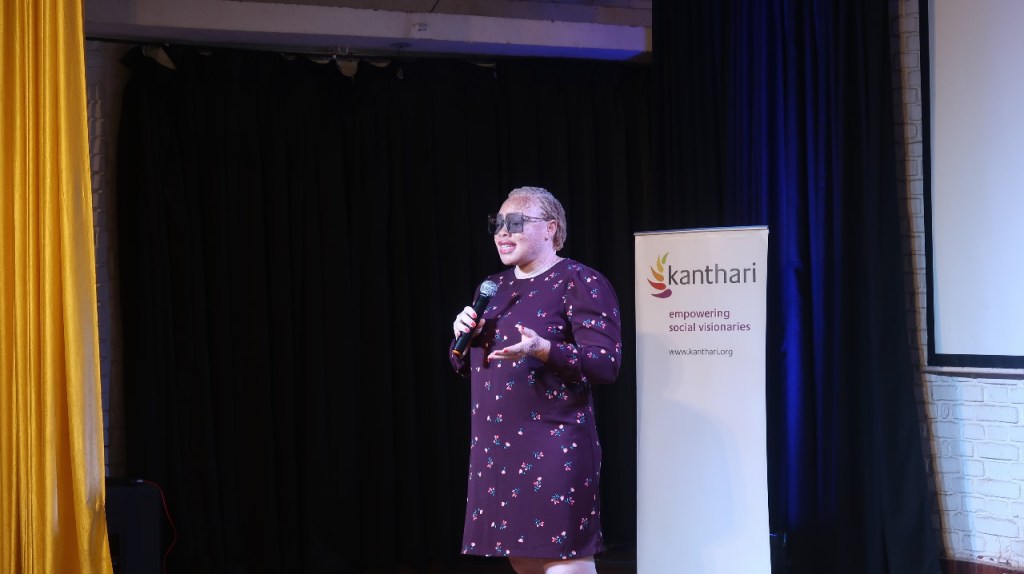
Gwenlisa shared how difficult it was to navigate leadership spaces, particularly as a woman with albinism. She spoke about feeling objectified and underestimated by men, particularly in male-dominated fields where her capabilities were often overshadowed by superficial judgments. Despite these challenges, Gwenlisa remained steadfast in her leadership, using her experiences to motivate other women with albinism to embrace their uniqueness and continue advocating for their rights.
“When they see me, they don’t think I have much to offer. They only see me as a woman… It’s all about sex. It’s all about who you are dating. So when can I see you?” She recalled interacting with some men. Her experiences reflect the broader societal attitudes toward women with disabilities, where their contributions are often overshadowed by objectification.
A Journey of Balancing Leadership and Personal Life
For Gwenlisa, the forum was also a reaffirmation of her commitment to leadership and advocacy within the albinism community. Her journey has been far from easy. As a single parent, a student pursuing her education, and the founder of the Alive Albinism Initiative in Zimbabwe, she has had to balance multiple roles, often with limited support. Yet, she remains steadfast in her efforts to empower others with albinism, using her story as a source of inspiration.
My journey as a female leader with albinism has not been easy given that I’m a single parent trying to raise the kids, trying to run an organization, and also doing my undergrad in special needs and inclusive education. Sometimes I’m dealing with issues of my own… but you cannot really tell your kids to say I have this going on, or you cannot talk to your beneficiaries to say I also need a hug. I also need someone to talk to.
Despite these challenges, Gwenlisa has thrived. She completed her undergraduate degree, is now pursuing her master’s, and continues to lead the Alive Albinism Initiative, which advocates for people with albinism in Zimbabwe. The initiative focuses on raising awareness about albinism, sourcing sunscreen, and empowering people with albinism to become self-sufficient. As Gwenlisa puts it:
We’re trying to look at empowering persons with albinism so that they can fend for themselves… buy their own sunscreen lotion.
A Catalyst for Change
The 2024 AAN Women’s Learning Forum was more than just an event; it was a powerful catalyst for change. It inspired women with albinism to take control of their narratives, embrace their leadership potential, and work collectively toward a more inclusive and just society.
We should not have limitations, we should not have boundaries. Once we think of something big, LET’S GO BIG.
Thank you Tapiwa Gwenlisa Mushonga for sharing your experience and for being such an inspiration!
Written by:

Anita Dianatinasab, student intern 2024-2025, University of Toronto, Canada.
Suhuyini Sulemana Seidu, student intern 2024-2025, University of Media, Arts and Communication, Ghana.

 Mothering & Albinism