
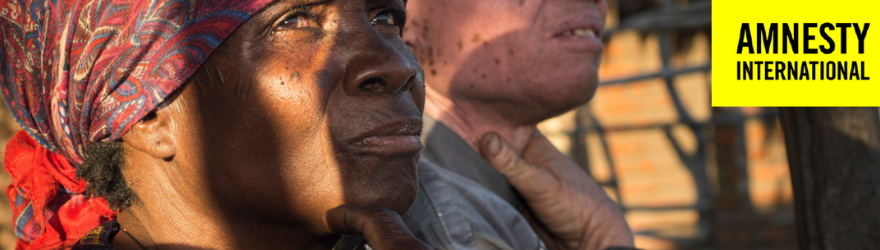
On June 12th, 2025, Amnesty International launched the Southern Africa Journal on Albinism and Socio-Economic Rights in commemoration of International Albinism Awareness Day (13th of June).
This year’s global theme: “Demanding our rights: Protect our skin, Preserve our lives.”
This journal is the first of its kind, focusing on albinism and Economic, Social, and Cultural (ESC) rights in Southern Africa. We are excited that our paper is amongst the first to be published in the inaugural journal.
Abstract
Mothers impacted by albinism in Africa encounter extraordinary circumstances, both as mothers of children with albinism and mothers who themselves have albinism. Albinism is a non-contagious, recessive, genetic condition that causes a decrease or absence of melanin in the skin, hair, and eyes. Persons with albinism experience low vision and the risk of skin cancer because of this genetic condition. They also deal with discrimination and stigma on account of their physical difference. In certain regions, deeply rooted spiritual and cultural beliefs about evil and misfortune persist, such that persons with albinism are ostracised and excluded. Women and girls with albinism are particularly vulnerable to human rights violations because of social constructions of gender that enable multiple and intersecting forms of stigma, discrimination, violence, and inequality.
In this paper, we focus on access to healthcare by mothers impacted by albinism in South Africa, and the inequalities and discrimination experienced by them. As a research-advocacy-policy network with team members from six countries, we are conducting ethnographic research on mothering and human rights, including mothers who themselves have albinism or have children with albinism. The aim of this four-year study is to explore, through a human-rights lens, the resilience of mothers affected by albinism, at the intersection of gender, colourism, and religion, in Tanzania, South Africa, and Ghana. In this paper, we focus on South Africa, where we conducted virtual and in-person fieldworkwith mothers impacted by albinism and key stakeholders engaged in human-rights related work. We draw on these data to illuminate mothers’ experiences in accessing healthcare. We apply a patient-centred access to health framework with the dimensions of: 1) Availability; 2) Affordability; 3) Accessibility; 4) Acceptability; and 5) Adequacy. Mothers continually face a complex array of societal and structural challenges in accessing healthcare, ranging from lack of evidence-informed care at the time of giving birth to an infant with albinism; lack of access to health information on how to care for an infant/child with albinism; lack of access to genetic counselling; and inaccessibility of services, including skin care and vision care, especially in rural locations where transportation may pose a challenge. Access to healthcare also involves the right to respectful, non-discriminatory care, given the stigma and discrimination faced by persons with albinism in the context of gender inequalities. We highlight how the social determinants of health profoundly impact access to healthcare and the achievement of the Sustainable Development Goals (SDGs) to ensure the economic, social, and cultural rights of mothers impacted by albinism.
Reference
Buyco, M., Reimer-Kirkham, S., Astle, B., de Waal, M., Kromberg, J., Mazibuko, N., Mgijima-Konopi, I, Mogale, S., Msipa, D., Strobell, E., Thabethe, M., Tjope, M. (2025). Access to healthcare by mothers impacted by albinism in South Africa. Southern Africa Journal on Albinism and Socio-Economic Rights. Click here.

 Mothering & Albinism