

We are proud to share a recently published academic article written by our brilliant first cohort (2023-2024) of undergraduate student interns as part of the Mothering & Albinism project. Their work highlights the importance of including students in research—not only as learners, but also as contributors to knowledge and advocacy.
Collaboration, engagement, and mentorship are at the heart of our work. By involving students, we expand the reach and depth of our impact, and foster the next generation of scholars/advocates/healthcare providers committed to protecting those most vulnerable. Raising awareness about albinism and the experiences of mothers and children affected by albinism is vital. We need as many allies as possible to protect and promote the human rights of people with albinism worldwide.
The article reports on the video analysis conducted as part of our knowledge synthesis about the experiences of mothers and families impacted by albinism. Please take a few minutes to read their insightful analysis!
Abstract
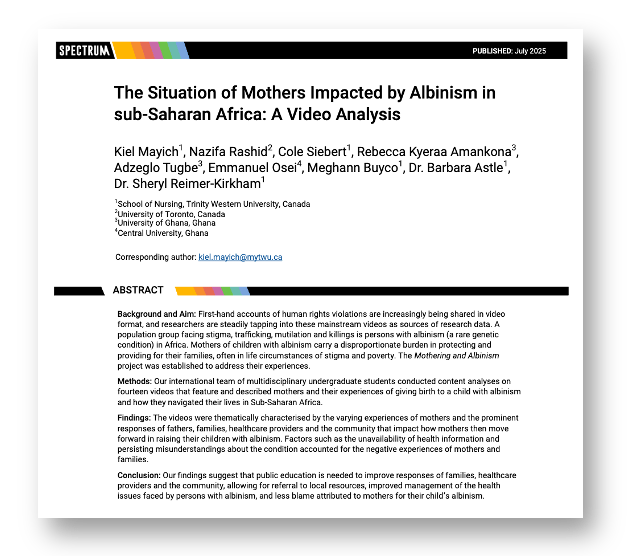
Background and Aim: First-hand accounts of human rights violations are increasingly being shared in video format, and researchers are steadily tapping into these mainstream videos as sources of research data. A population group facing stigma, trafficking, mutilation and killings is persons with albinism (a rare genetic condition) in Africa. Mothers of children with albinism carry a disproportionate burden in protecting and providing for their families, often in life circumstances of stigma and poverty. The Mothering and Albinism project was established to address their experiences.
Methods: Our international team of multidisciplinary undergraduate students conducted content analyses on fourteen videos that feature and described mothers and their experiences of giving birth to a child with albinism and how they navigated their lives in Sub-Saharan Africa.
Findings: The videos were thematically characterised by the varying experiences of mothers and the prominent responses of fathers, families, healthcare providers and the community that impact how mothers then move forward in raising their children with albinism. Factors such as the unavailability of health information and persisting misunderstandings about the condition accounted for the negative experiences of mothers and families.
Conclusion: Our findings suggest that public education is needed to improve responses of families, healthcare providers and the community, allowing for referral to local resources, improved management of the health issues faced by persons with albinism, and less blame attributed to mothers for their child’s albinism.
Reference
Mayich, K., Rashid, N., Siebert, C., Amankona, R., Tugbe, A., Osei, E., Buyco, M., Astle, B., & Reimer-Kirkham, S. (2025). The situation of mothers impacted by albinism in sub-Saharan Africa: A video analysis. Spectrum, 15. https://doi.org/10.29173/spectrum303

 Mothering & Albinism